Sharpie’s Album of the Year 2023

The Candle & The Flame – Robert Forster
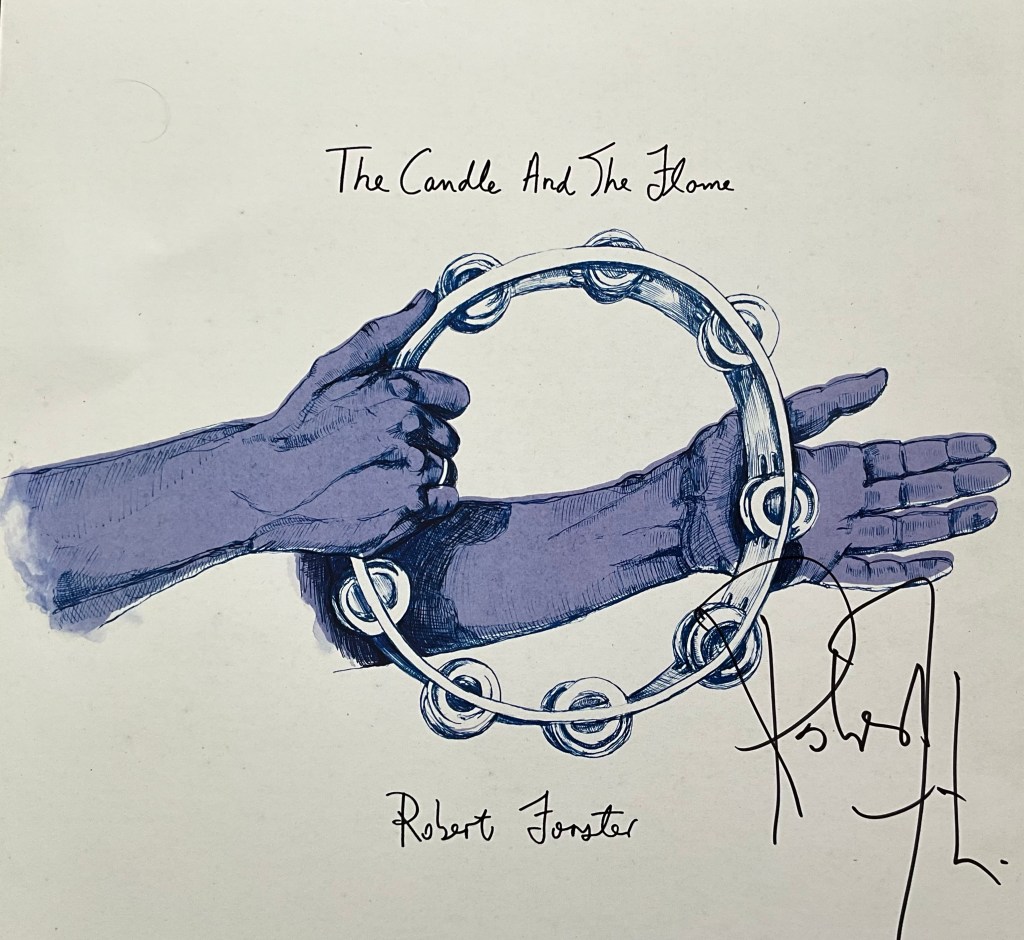
Robert Forster is well known as, together with Grant McLennan, one of the founding members of The Go-Betweens. Together with Grant McLennan, he was responsible for some of the finest songs in Australian rock and pop. Forster specialised in literate, wry, lyricism dealing with often obscure topics from Lee Remick to Surfing Magazines and German Farmhouses. Those songs were, for the most part delivered with spritely jangling guitars which earnt the description of ‘that striped sunlight sound’.

Those well honed skills have served Forster well with the Go-Betweens, and onward through his solo career. But never have those skills been quite so critical to an album’s success than on his 2023 release ‘The Candle and The Flame’ – an album of ruminations on his wife Karin Baumler’s battle with cancer. Not since his solo debut Danger in the Past in 1990 has Forster delivered an album this focussed and compelling.

The topic of cancer could, in lesser hands, make for heavy going, but, infused with that striped sunlight sound, wry lyricism and with backing by family members Karin, son Louis and daughter Loretta (together with sometime Go-Between Adele Pickvance) these tracks are light, bright and uplifting while never skirting the realities of Baumler’s illness. It’s a masterful trick and one which elevates this album to a state of grace, hope, celebration and most compellingly a (sacharine-free) tribute to the power of love.

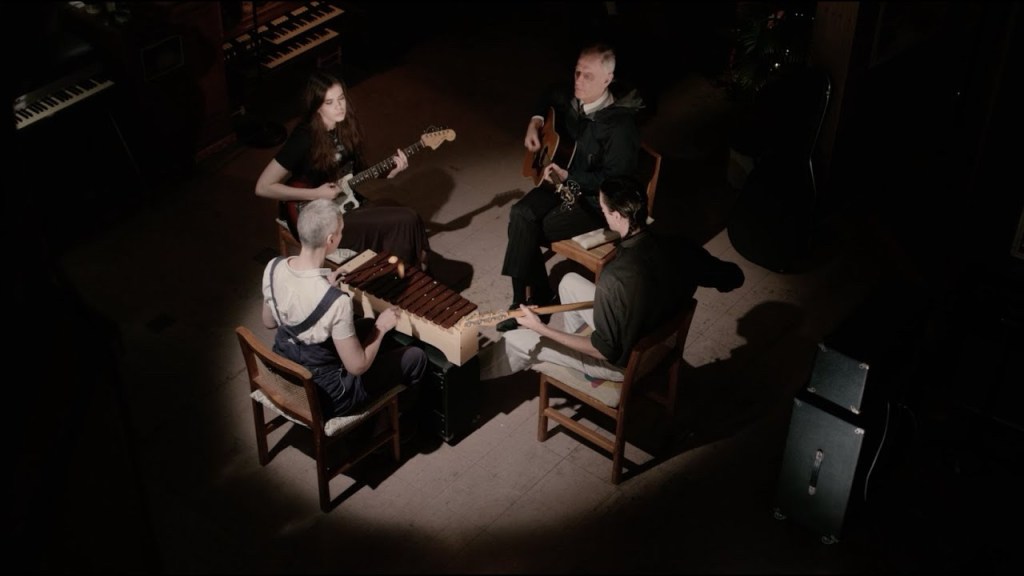
Opener, She’s a Fighter makes do with a mere 5 words (She’s a Fighter, Fighting for good). It was taped live with Forster, Karen, Louis and Loretta arranged in a circle playing this mantra over a propulsive tune similar to the great train songs beloved by blues players past and a neat finger picked riff which imbues the song with strength, determination and hope.
It’s followed by ‘Tender Years’, a reminisence on Forster’s relationship with Baumler through the years, which speaks to the depth of love and partnership fortified by shared experience, time and memory, together with fear that it may soon end:

‘I know it’s growing daily, lately I see how far we’ve come/I’m in a story with her, I know I can’t live without her/ I just can’t imagine one’.

It’s the best track on the album and the equal of anything Forster has written.

The other high point of the album comes on the first track of Side Two in the form of ‘I Don’t Do Drugs, I Do Time’ which melds memories, perspective and precious time into a joint declaration by Forster and Baume (sharing vocals) that, together they will make the most of every moment they have together: ‘I don’t do drugs, I do time/ Make it stop and rewind/ Reimagine, redefine/ Recondition, realign/ Reelected, not resigned/ I don’t do drugs/ Baby, I do time’.

That Forster has managed to make an album, dealing this honestly with his wife’s cancer, which is beautiful, joyous and uplifting is a minor miracle. That he’s done it as a family project brings an added depth, honesty and more than a little magic.

Book Review: Stranded by Clinton Walker (2021 revised and expanded edition)

Clinton Walker’s updated 2021 edition of Stranded, while billed as a chronicle of the Australian independent music scene from 1976 to 1992, is much more than that. It’s also part thesis on the workings of the independent record labels, distributors, stores, venues and characters which drove the scene, and part fractured memoir of Clinton’s participation in the scene (as critic, record store clerk, PR man and general ‘friend of the band’).

Clinton doesn’t try to review the output so much as observe it from his, admittedly prejudiced, viewpoint as a pro-indy anti-establishment participant.

It’s wonderful to follow in detail the development of the scene from The Saints and Radio Birdman, through The Boys Next Door/The Birthday Party, Go-Betweens, Scientists/Surrealists, Laughing Clowns/Ed Kuepper, Beasts of Bourbon/Cruel Sea, The Moodists/Dave Graney, The Triffids, Died Pretty and Hoodoo Gurus – along with a host of other bands. Some you’ll likely remember, some you’ll likely not.

Because the book is a personal chronicle, rather than purely a historical account, it benefits from an amazing array of first hand anecdotes and personal observations from the author. But it is, in equal part, burdened by the author’s staunch prejudices.

Bands like The Church are dismissed blithely for being too eager to be rock stars. There are other notable omissions such as the great Ups & Downs whose debut was self-released in 1983 before the band moved to Volition, Truetone and ultimately Mushroom. They would have seemed an ideal candidate for Walker’s thesis but don’t rate a mention despite both hitting the mainstream charts and being nominated for best new talent category in the inaugural ARIA awards in 1987 (the award was won by Crowded House).

Those whose record collection boasts Australian releases on independent labels like Au Go Go, Missing Link, Hot, Citadel, Big Time, Volition, Truetone, Waterfront, Red Eye, Shock, Phantom etc. will enjoy the inside glimpse of the people behind the labels and the connections between them.

The most rewarding aspect of the new 2021 edition is the addition of numerous footnotes and a new Preface and Afterword in which Walker reflects on his own prejudices:

‘I feel quite differently now about much of the music from that period. I was able to finally cast off my blinkers and listen without prejudice to, say, Cold Chisel, and hear a lot to like’.

But the reassessment goes only so far:

‘although other bands I disliked back then – the Oils or the Angels, for example – still leave me cold.’).

Ultimately Walker’s new Afterword chooses to re-conclude his thesis through the person of Peter Milton-Walsh, sometime Go-Between and Laughing Clown and leader of The Apartments. The Apartments has released seven studio albums (at least two of which Walker describes as ‘masterpieces’) plus two live albums and several single/eps over 25 years. During that time it has featured members and collaborators including: Greg Atkinson (Ups & Downs), Wayne Connolly (who might have rated a mention in the latter part of Walker’s book a mentioned as a member of The Welcome Mat from 1989 and a producer at Paradise Studios, home to RooArt records and as producing early work by You Am I – and went on to further achievements in Knievel and as a multiple ARIA award winning producer after the timeframe covered by Stranded) , Amanda Brown (Go-Betweens), Chris Abrahams (The Necks, The Sparklers) and Nick Kennedy (Knievel and Red Eye Records in Sydney).

Milton-Walsh, a close friend of Walker, is taken to be emblematic of the great unsung heroes of Australian music who have plowed their trade and produced a body of work to rival many household names, yet remain largely anonymous (often receiving greater recognition overseas than in Australia) barely earning a living from their talent.

It’s a fitting post-script with which discerning music fans all over the country would readily agree and likely add a list of their own. Mine, for example, would include – in addition to Peter Milton-Walsh – Rob Snarski, David Bridie and Chris Wilson for starters [Rob Snarski and David Bridie are mentioned in Stranded. Wilson curiously is not, though Harem Scarem, for whom he played harmonica and saxophone, does get a few positive passing mentions on pages 260-261].

The new edition’s revisions further support and refine Walker’s thesis and, in part, address some the original’s shortcomings. Overall, the book is a rollicking read and remains essential for anyone interested in the history of independent Australian music.

Highly recommended.